
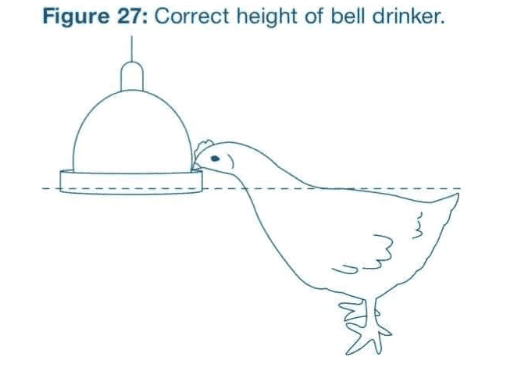
For water provision to remain accessible for flocks, you’ll need to adjust the height of the bells to suit the size of the birds.
Too high and birds can’t access water and suffer.
Too low, and birds can easily contaminate the water, spill it, and soak the surrounding litter, encouraging bacterial growth and resource waste.
Better uniformity minimises the risks associated with bell drinkers that are too low.
This is because you cater to the smallest or weakest among the flock.
Adjusting the height of a bell drinker
It’s recommended that the lip height of a bell drinker should be level with the back of your birds when they stand upright.
(Image source: Poultry Farmer’s Forum)
But as you will remember from the growth rate of poultry, your birds grow at a rapid rate, gaining as much as 5x their body weight within the first 7 days.
As such, your farm stockmen must be ready to regularly measure and adjust the height of the bell drinkers to suit your flock.
Water level from the top of the lip
Aside from the height of the bell drinker against the standing height of the bird, is the level of the water inside the lip.
This also needs to be adjusted to the bird’s size/age.
It is recommended that the water level be 0.2 inches from the top of the drinker lip on Day 1 from the hatchery.
(With the bell itself the same height as the chicks’ backs, the water level at 0.2 inches from the top of the drinker lip is optimal for access).
The water level on Day 7 should be 0.5 inches from the top of the drinker lip.
Adequate space per bird at the bell drinkers
It is recommended that you provide a bell drinker per 75 birds and a minimum of 0.6 cm (0.24 inches) drinker space per bird.
This ensures there is no competition for water.
For where there is competition among the flock, there is a drop in uniformity of production.
What does your bell drinker management program look like? Do you have a documented plan?

Leave a Reply