
Ambient poultry house temperature is a catalyst for peak production.
Broilers or layers that are reared at optimal temperatures are more likely to grow and produce at their genetic potential.
But there are some caveats and nuances to observe.
And in achieving this goal, the 3 contributing factors are:
- air circulation (ventilation)
- distribution
- insulation
The 3 factors above are important for determining how evenly spread and consistent the ambient temperature is.
The more evenly distributed and consistent the optimal ambient temperature, the more uniform the results will be amongst your poultry flock.
But there are different methods for achieving that ambient temperature within a poultry house.
Here are some of the most common:
Methods of heating a poultry house
Forced air heaters
These heating systems continually generate and throw out hot air.
The thermodynamics are such that the hot air (100%) immediately rises to the ceiling. And as such, the hot air requires redistribution by circulation fans. If not circulated, the heat would not be felt by the birds.
But be careful not to place the heaters too close to the birds, lest you expose the birds to drafts. It’s recommended that the heater be 1.4 to 1.5 m (4.7 to 4.11 ft) from the floor.
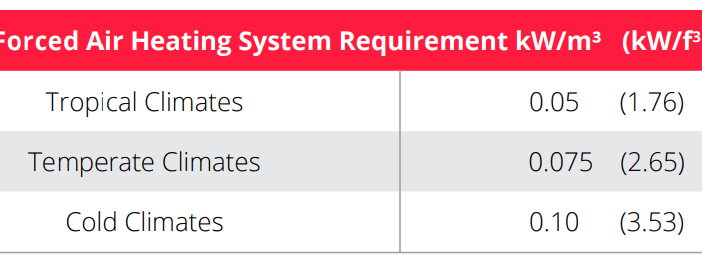
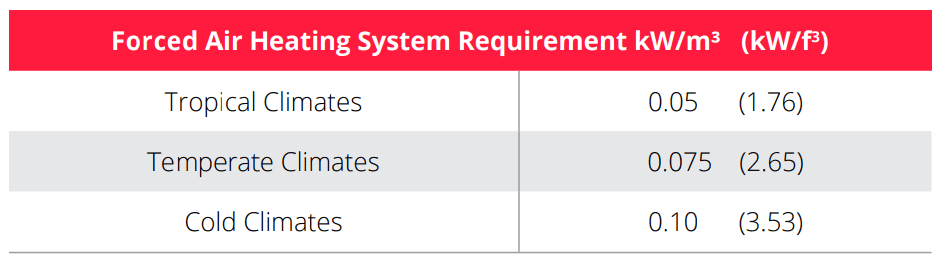
Here’s a table indicating advised power output depending on climate:
Underfloor heaters
Commonly installed in particularly cold climates. Underfloor heating in poultry houses is delivered via underfloor hot-water piping.
The concrete floor of the structure readily absorbs the heat from the pipes.
This heat is gently conducted by the litter, providing a gentle yet direct source of heat to the birds.
Radiant / spot brooders
Especially because of the chicks’ fragility in the first few days of life, brooder heating is critical to get right.
It’s a major contributor to their comfort and willingness or ability to find adequate feed and water.
Due to the focused nature of heat distribution from radian tor spot heaters a major factor to their performance success is coverage.
It’s a bit like playing jigsaw with the heaters.
Each heater’s pattern of heat distribution is laid up against that of neighbouring heaters to produce an interlocking blanket coverage for the flock.
How many you need is directly dependent upon the heat capacity and distribution of each heater.
Uniformity is key as always to passing on the optimal benefit to the birds.
A particularly uniform method of radiant heating for broiler brooder houses is hot water piping within the cavities of the broiler house (walls and ceiling).
Key considerations:
Monitoring: the placement of sensors must be tailored to the heating system. You want to sample the ambient temperature and not the direct effect of the heating system.
Effectiveness: selecting a heating system must match the age of the birds and the climate. For example, the constant static heat of the radiant brooder is the ideal method for gently heating chicks. But at two weeks of age forced-air heater become more appropriate.
Insulation: the direct delivery of radiant heat is the ideal solution for a poorly insulated poultry house.
Circulation fans: forced air heating combined with circulation fans that evenly distribute heat throughout the poultry house will generate the most productive results.
Fuel efficiency and cost: bringing all provision back to cost and profit, selecting the most fuel efficient heating system will add optimal economic value (profit) to your business bottom line.

Leave a Reply